NT GREEK STUDIES
  • Home
  • Blog
  • Resources
  • Self Study
  • About
  • Contact

What happened?

6/29/2019

0 Comments

 
It has been a long time since new content or updates were posted here. I want to let anyone reading know that I am well, and will be continuing the website and blog. We are not going anywhere. It remains my desire to be able to help encourage others in their pursuit of reading the New Testament in its mother language.

Where have I been? To put it simply; life happened. Being a husband and father, moving, work, etc, has taken all of my time. I feel now that I am at a place where I can continue with this project.

Thank you to anyone who has followed and supported the page over the years. I truly am grateful and appreciate it. Please feel free to write with any questions, to share your studies, and always be sure to check our Facebook page for updates.
0 Comments

New Greek Grammar!

1/19/2015

0 Comments

 
Picture
During the life of Rod Decker (1953-2014) he made many contributions to the body of Christ. Before passing into eternity he left us with what is a refreshing, ground breaking, and needed first year Greek Grammar.

We have been immensely blessed in the past 2 decades with first year Grammar books (Mounce, Black), yet they are both 20+ years old, and have their own individual teaching styles. What Decker offers is a new face, fresh voice, and distinct style. I highly recommend both Mounce and Black, but this new book should not be ignored, and would make a great companion to one of the other volumes, if not a primary.

You can visit Rod's blog here. It contains a lot of interesting and helpful information from years past.

His grammar can be purchased here.

0 Comments

UBS4 Reader's Edition - Limited Time!

1/15/2015

0 Comments

 
The UBS4 Reader's Edition GNT has been out of print for nearly a year. We knew this would happen sometime after the release of UBS5. BUT! I just noticed on CBD that it is being sold for $19.95. My guess is as good as yours, it won't be there long. CBD must have bought up some extra stock. Get yours while they last.

Any of you who have followed this blog for a while know that the UBS Reader's GNT is a favorite of mine. The font is larger and easier to read than the standard UBS, not to mention the rare forms and vocabulary are listed at the bottom, making this a great daily devotional Reader.

The UBS Greek New Testament: Reader's Edition
0 Comments

Importance of the Original Languages - Miles Van Pelt

8/12/2014

0 Comments

 
Picture
An excellent interview with Miles Van Pelt on the importance of the Original Lanuages and the importance of studying, learning, and maintaining them for ministry.
Miles Van Pelt, Associate Professor of Old Testament and Academic Dean at Reformed Theological Seminary in Jackson, MS speaks about the importance of the original languages for biblical study.  Miles has helped produce several popular books and resources for original language study including Basics of Biblical Hebrew and Vocabulary Guide to Biblical Hebrew.   Dr. Van Pelt encourages pastors and scholars to a renewed sense of the importance and efficacy of biblical study in Greek and Hebrew.
Listen Here
0 Comments

Why the Biblical Languages Matter - Michael Kruger

8/1/2014

0 Comments

 
Michael Kruger has a very helpful website called Canon Fodder, that I would encourage anyone interested in the study of the New Testament to check out.  In this article he discusses some of the benefits of learning and maintaining the languages after initial study. I encourage you to visit the link below and give it a read.

Why the Biblical Languages Matter - Even if You Forget Them
0 Comments

Greek for Children

2/9/2014

0 Comments

 
Picture
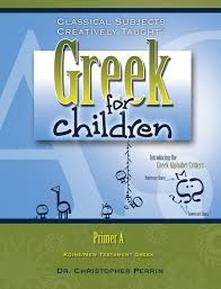
Children learning Biblical Greek? I know, it may seem to you like an impossibility for a child to learn such a language. Sadly, for many children this may be true. If during the early and formative years of a child's life, they child spend a significant amount of their time watching TV, playing video games, and engaging in other mind-numbing activities instead of exercising the mind and training it to think critically, then it will be exceedingly difficult to learn NTG. This is exactly the problem for many adults as well. Some of us have become products of our mentally-lazy and no-effort generation, and as such, we often cringe at the thought of learning a foreign tongue. We think, "Oh, that's just too hard for me, I could never do that" or "That's for pastors" or "I didn't go to seminary", etc. Anyone can learn Biblical Greek, and a child certainly has an advantage over an adult. This language is far more accessible to the average person than is commonly believed. It can be learned! Why not teach it to your child so that they can read the NT in its original language?

Please comment and offer thoughts, ideas, resources, experience, etc.

Books for Teaching Children:

Biblical Greek 4 Kids: Book 1 - Ashlyn McKnight Perkins (currently out of print)
        (Great for smaller children ages 3-6)

Greek for Children Primer A - Christopher Perrin
        (Recommended for ages 8-12)

Greek for Children Primer A Answer Key - Christopher Perrin

For those parents who have a basic knowledge and grasp of NTG and will be teaching their children, I suggest using The Basics of Biblical Greek from Bill Mounce. If the parent knows Greek, this book can serve to be a very helpful guide for children ages 6-12 who have a simple understanding of basic English grammar. This book is extremely user friendly and very understandable.

Kid's Greek from Bill Mounce
Bill Mounce is developing a teaching program to help parents teach their children the language of the New Testament, and in turn understand and study the Bible better. Yes! children can learn Greek too! It is still under development, but seems very promising and positive.

Greek Songs: These aren't just for kids!
  • The following materials are freely provided by Teknia.com
  • MP3 audio & PDF lyrics are linked below

1.     The Alphabet Song        mp3        PDF

2.     Jesus Loves Me             mp3        PDF

3.     Doxology                        mp3        PDF
0 Comments

UBS5 is Here

2/9/2014

0 Comments

 
Picture
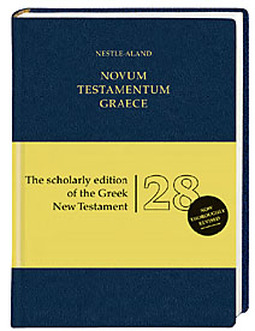
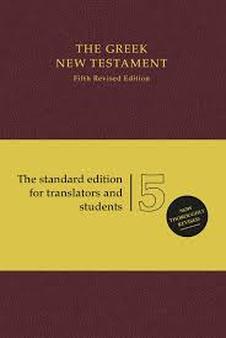
Last spring I noted here that the NA28 had been released and wondered if anyone was jumping on board. I for one did not, and don't plan to. Well, now the UBS has released its fifth addition of the GNT. The differences between the NA27/UBS4 to NA28/UBS5 are minor. 

My personal advice would be not only to stick with the UBS4 (or UBS3), but to buy several copies of it while you can, for future use when your current one gives way, and to give away as a gift, before they are out of print. UBS5 is selling for $50-60, sure prices will come down, but it will be a few years before they do.

I also suggest buying a copy or two of the wonderful UBS Greek New Testament: A Reader's Edition while you still can. There is only one version of it left in print now!

0 Comments

The Process of Exegesis

8/7/2013

5 Comments

 
Today we often hear the term exegetical preaching. But what exactly does this mean? What is exegesis? Exegesis could simply be referred to as: the process of drawing out of a passage or verse what is contained therein. The great enemy to exegesis is eisegesis, which is reading into a passage what is not there, by forcing one’s own thoughts into the passage and making it say something which it was never intended to say. You may have guessed it, that much of the preaching today is far from exegetical, but rather is eisegetical, men imposing their own thoughts, ideas, forced modern day applications, and agendas into the text, instead of letting the text do the speaking.

It is important to note however, that the forerunner to exegetical preaching is exegetical study. You can’t have the former without the latter. You can’t have exegetical preaching simply by picking up a commentary or two, or clicking a few buttons in the computer program. It’s not that easy. I don't want to discourage anyone from pursing the exegetical study of the Word of God. It really is not that difficult, but does require certain tools and discipline. If you have any questions, don't hesitate to leave a comment.

These are some notes I took while reading Dave Black's book, "Using New Testament Greek in Ministry". I feel he does a great job of simplifying the task of exegesis.

Exegetical Process

I.    Discovering the Text

        A.      Historical Analysis
Author, audience, date, occasion, purpose, cultural and sociological influences, other related background matters.

        B.      Literary Analysis
Canonical – place in Bible itself
Remote – paragraphs, chapter, or even entire book
Immediate – verses or paragraphs that immediately precede or follow the text

II.    Understanding the Text

        A.      Textual Analysis
Attempt to determine the original wording of a document – Textual Criticism

        B.      Lexical Analysis

Determine the meaning of the words in the text – Word study

        C.      Syntactical Analysis
Involves attention to clauses and other unites that are larger than individual words. Also includes matters of tense, voice, mood, person, number, and case of individual words. Helps to determine an author’s thought patterns. Syntax is concerned with the meaning of words in their combination with other words.

        D.      Structural Analysis
Concerned with the ways clauses and larger thought units are placed in relation with each other. Cannot be translated into another language, because translators must use the grammatical system of the target language. Diagramming a passage can be helpful in determining its structure.

        E.       Rhetorical Analysis
RA is an attempt to clarify our understanding of the biblical text through a study of its literary techniques.
5 Comments

Goals in Learning Greek

8/7/2013

0 Comments

 
In the past I’ve talked about the reasons someone should study Greek. I’ve also talked about the correct motives for studying Greek. Actually, you'll find those two topics strung throughout this website. Here I’d like to share some simple thoughts about reasonable goals in Greek study. If we don’t set goals for ourselves, we are likely not to make much progress. That is especially true of myself. The following is an extract from Dave Black’s wonderful book “Using New Testament Greek in Ministry”.

  • R-1 is elementary proficiency. Anyone can achieve this goal – which involves a knowledge of the Greek alphabet and a very basic understanding of some of the language aids available today.
  • R-2 is limited working proficiency. At this stage you can read uncomplicated but authentic prose in Greek that contains common words and basic sentence patterns. You will still rely heavily upon on dictionary.
  • R-3 is professional proficiency. Here you can grasp the essentials of standard but uncomplicated prose without the use of a dictionary.
  • R-4 is full proficiency. At this final stage, you can read anything written in the foreign language without a dictionary. A very large vocabulary is the key that unlocks the door to this level.

A Few Thoughts:

R-1 is basically what a lot of pastors and Bible study leaders do. It is to learn enough to conduct word studies and use computer programs. As one friend once told me, it is learning enough Greek to "be dangerous". I would discourage anyone from pursuing this type of study. This kind of study boils down to using a concordance and/or a computer program. Most exegetical fallacies stem from people who really do not know or grasp the language, but rather pick up enough to "be dangerous" and make claims about Greek which are often incorrect. For more on this, please this post: Exegetical Fallacies

R-2 is the stage where most students are who have had at least one year of Greek, or completed an introductory Grammar book such as those from Bill Mounce or Dave Black. This is a good place to be, but by no means a place to rest and become content.

R-3 is, according to Dave Black, the place where many seminary and Bible college professors are. At this stage one may read the GNT daily in a devotional way, but still comes across the occasional word or phrase that must be looked up. This is attainable after 2-3 years of study, if the student is diligent and consistent.

R-4 should be the goal for all Greek students. It will take much dedication, consistency, and time to reach this place, but it is possible. I would say about 5+ years for the serious, devoted student. The thing which really seperates R-3 from R-4 is vocabulary. The only way to bridge the gap is daily reading.


So what are your goals? Where are you at right now? Right now I am trying to move on from R-2 to R-3. The only thing hindering me is myself, the lack of discipline and consistency.


0 Comments

Textual Commentary of the Greek NT

7/3/2013

0 Comments

 
Picture
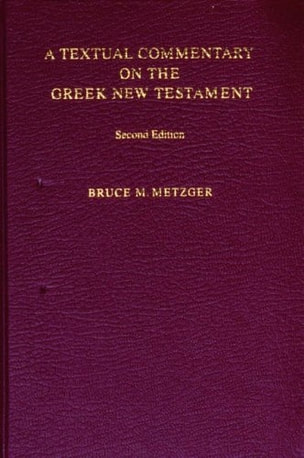
In a previous post I briefly wrote about the topic of Textual Criticism and recommended a few resources to help start you on your journey. If you have already watched Dan Wallace's excellent series on TC, and/or read Dave Black's NT Textual Criticism, then let me introduce you to what is probably the most significant contribution ever to TC.

Upon opening, it is not hard to see how this textual commentary is the most helpful tool on the planet for TC. Without bogging the reader down, Bruce Metzger has chosen all of the important Textual Variants in the Greek New Testament and compiled a commentary explaining the support for and against the different readings.

One of the many benefits of this work is that it addresses the significant variants between the Alexandrian and Byzantine Manuscripts (The Alexandrian or Critical Texts were used for the NASB/ESV, whereas the Byzantine were used for the KJV/NKJV). Metzger also provides excellent research and commentary on passages such as John 7:53-8:11 (the woman caught in adultery), and the much debated Mark 16:9-20, and discusses based on evidence, whether they were originally in the New Testament or were later additions.

A few notes about using this commentary:
  • In order to fully utilize this tool, the UBS4 GNT is needed. It is linked to below.
  • Also, at least one year of Greek Grammar is needed to be able to use this. In other words, you need to have a working knowledge of the language.

A Textual Commentary on the Greek New Testament (Companion to the UBS4 Greek NT) - Bruce Metzger

The UBS Greek New Testament 4th Edition

0 Comments
<<Previous
Forward>>
    HOME

    Read the Greek New Testament Online​

    Importance of the Biblical Languages

    NT Commentaries & Reviews

    Categories

    All
    Books
    Canon
    Children
    Exegesis
    Exegetical Fallacies
    General
    Gospels
    Humanity Of Scripture
    Imperative
    Motives For Study
    Participles
    Pronouns
    Reading Greek
    Reading Plans
    Resources
    Self Study
    Synoptic Gospels
    Textual Criticism


    Archives

    January 2026
    December 2025
    November 2025
    October 2025
    July 2019
    June 2019
    January 2015
    August 2014
    February 2014
    August 2013
    July 2013
    April 2013
    November 2012
    September 2012
    May 2012
    April 2012
    March 2012
    February 2012
    January 2012
    December 2011
    November 2011
    October 2011
    September 2011
    August 2011


    Pages I like

    Bill Mounce's Blog
    CSNTM - Dan Wallace
    ​Daily Dose of Greek
    ​Greek Study App


Navigation

Home
Blog
NTG Resources
Self Study Greek
About
Contact
Are You Saved?
Español

Motivational Quotes:

Another result when pastors do not study the Bible in Greek and Hebrew is that they, and their churches with them, tend to become second-handers. The harder it is for us to get at the original meaning of the Bible, the more we will revert to the secondary literature. For one thing, it is easier to read. It also gives us a superficial glow that we are “keeping up” on things. And it provides us with ideas and insights which we can’t dig out of the original for ourselves. - John Piper

Not only is this the only well from which we can draw the original force and meaning of the words and phrases of divine utterance, but also those languages (Hebrew & Greek) possess a weight of their own – a vividness which brings home to the understanding fine shades of meaning with power which cannot survive the passage into another tongue. - John Owen
Copyright 2011-2026 | NT Greek Studies | All Rights Reserved
  • Home
  • Blog
  • Resources
  • Self Study
  • About
  • Contact